
Price Monitor. Every competitor. Every morning.
Daily competitor price tracking for the SKUs that drive your revenue. We scrape your competitors at 06:00, surface every change, and connect the dots between price moves and your sales — so you stop reading your revenue and start reading the market.
Built for price monitor that actually need to move the needle.
Concrete deliverables. No fluff, no slideware.
Every output below is something you keep — a document, a fix, a system, a decision. Nothing is ‘discovery findings’ that vanish at the end of the engagement.
Daily competitor price snapshots
06:00 GMT scrape of every monitored SKU × competitor pair. JSON-LD, microdata, OpenGraph, CSS, and regex extraction — multi-method for reliability.
Sales-impact analysis
We correlate competitor price moves with your daily sales of the same SKU. The hidden chart that explains half your unexplained dips and spikes.
Daily alert email
One email a day at 07:00 with: who changed price overnight, by how much, your current rank vs competitors, and the priority items needing review.
Price sensitivity scoring
Per-SKU score showing how elastic your demand is to price changes. The decision support behind ‘should I match, hold, or undercut?’
Promotion pattern detection
When a competitor consistently runs promotions — Mondays, payday weekends, end-of-quarter — you'll know the pattern within 30 days.
Live dashboard
Web dashboard showing current rank, price gap, history, and alerts. Filter by category, brand, competitor, or stock status.
Digital Business Manager managed
Your Digital Business Manager at Coffee Marketing curates the SKU list, swaps in new ones each month, and reviews findings on the monthly call. Not a self-serve tool.
Service Level Agreement
92%+ scrape coverage as a rolling 30-day SLA. Below that and we apply automatic credit. Published transparently — nobody else does this.
What changes in your business.
You stop being surprised. Every morning your team knows what's changed in the market overnight and which decisions need attention. Pricing arguments stop being opinion-based and start being evidence-based.
Within 60 days the system will have quantified the actual relationship between competitor pricing and your sales — for many clients this changes how they run promotions entirely.
A clear, predictable process.
Onboarding
30-minute kickoff. Confirm SKUs, competitors, alert thresholds, and email recipients.
Setup & validation
We configure the scraper, validate selectors per competitor, and run a 7-day stabilisation period before alerts go live. ~5 working days.
Daily operations
06:00 scrape → dashboard refresh → 07:00 alert email. The system runs by itself.
Monthly review call
60-minute call with your Digital Business Manager each month: what's changed, what to act on, which SKUs to swap in or out for next month.
Quarterly strategic review
Deeper review every quarter — sensitivity scoring, promo pattern report, recommended pricing strategy adjustments.
What you actually receive.
The deliverable shape, not real client data. Synthetic numbers and identifiers used throughout.
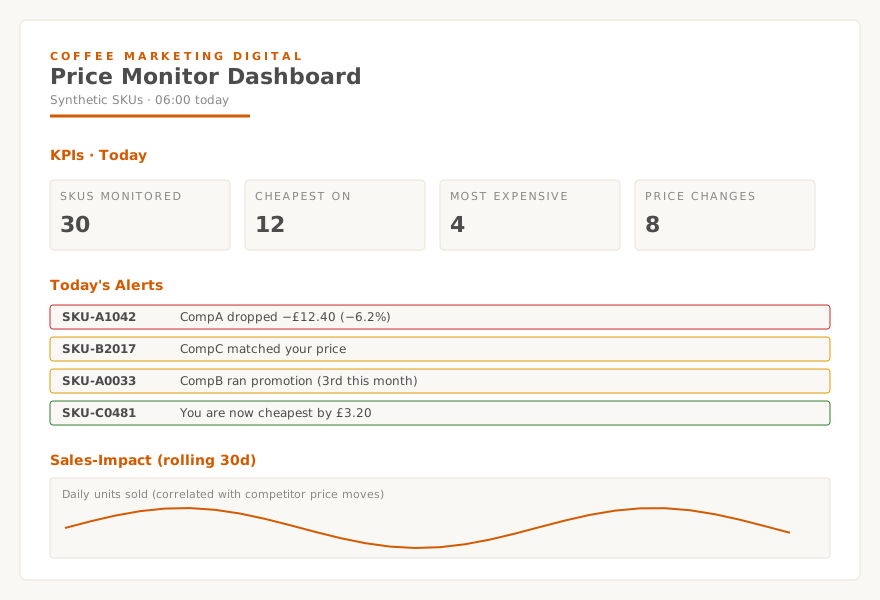
Best aligned to All Stages of the Digital Marketing Maturity Model.
This is one of our supporting services — designed to close a specific gap in your team or operation. Optional, scoped to fit, and never obligatory. If we don't think you need it yet, we'll tell you.
Indicative price. Final quote tailored.
We can't give a single fixed price for every business — what's straightforward for one client is complex for another. The figure below is the floor; your final quote depends on the variables underneath it.
From
Daily competitor price tracking for the SKUs that drive your revenue.
What governs which tier you need
- Number of SKUs you want monitored: typically 10–30% of your catalogue is enough to cover 80% of your revenue.
- Number of competitors you track per SKU: 5 is a good default. Some clients run 3, others 10.
- Marketplace coverage: Amazon, eBay, and other marketplaces are higher-effort to scrape — they push you towards a higher tier.
- Alert sensitivity & frequency: default is daily digest. Real-time alerts on critical SKUs are an add-on.
- Custom integrations: writing the price feed into your ERP, BI, or pricing engine is a separate one-off project.
The questions businesses actually ask.
What is a SKU × competitor pair?
Each pair is one combination of one of your SKUs and one competitor's product page. Example: 10 SKUs across 5 competitors = 50 pairs. The Watch 150 tier covers 150 pairs, typically 30 SKUs across 5 competitors.
Can we just buy the data and run our own analysis?
No — Price Monitor is a managed service. The dashboard, alerts, and sensitivity scoring all come together as a package. Your Digital Business Manager curates the list and reviews the findings monthly.
What if a competitor blocks scraping?
We use UK residential proxies and stealth browsers. Coverage SLA is 92%+ rolling 30-day. If we can't reliably scrape a specific competitor, we'll tell you on month one and exclude or swap.
Do you do dynamic price-matching?
We surface the data; we don't auto-change your prices. That's a deliberate choice — pricing decisions need human judgement, not algorithmic auto-match.
What's the contract length?
Monthly rolling. No long-term commit. Cancel any time, no exit fee. We're confident the value is obvious by month two.
Experience you can trust.


Ready to take the next step?
Book a 30-minute strategy call or request a tailored quote. Real people, real expertise, no junior-account-handler waste of time.