Manual bidding is dead. Here’s what your agency should be doing instead.
For a long time, the story agencies sold was simple: we manage your bids so you don’t overspend. We watch the numbers, we adjust the levers, we protect your budget. There was genuine skill in that. There still is - but it’s no longer where the competitive edge lives.
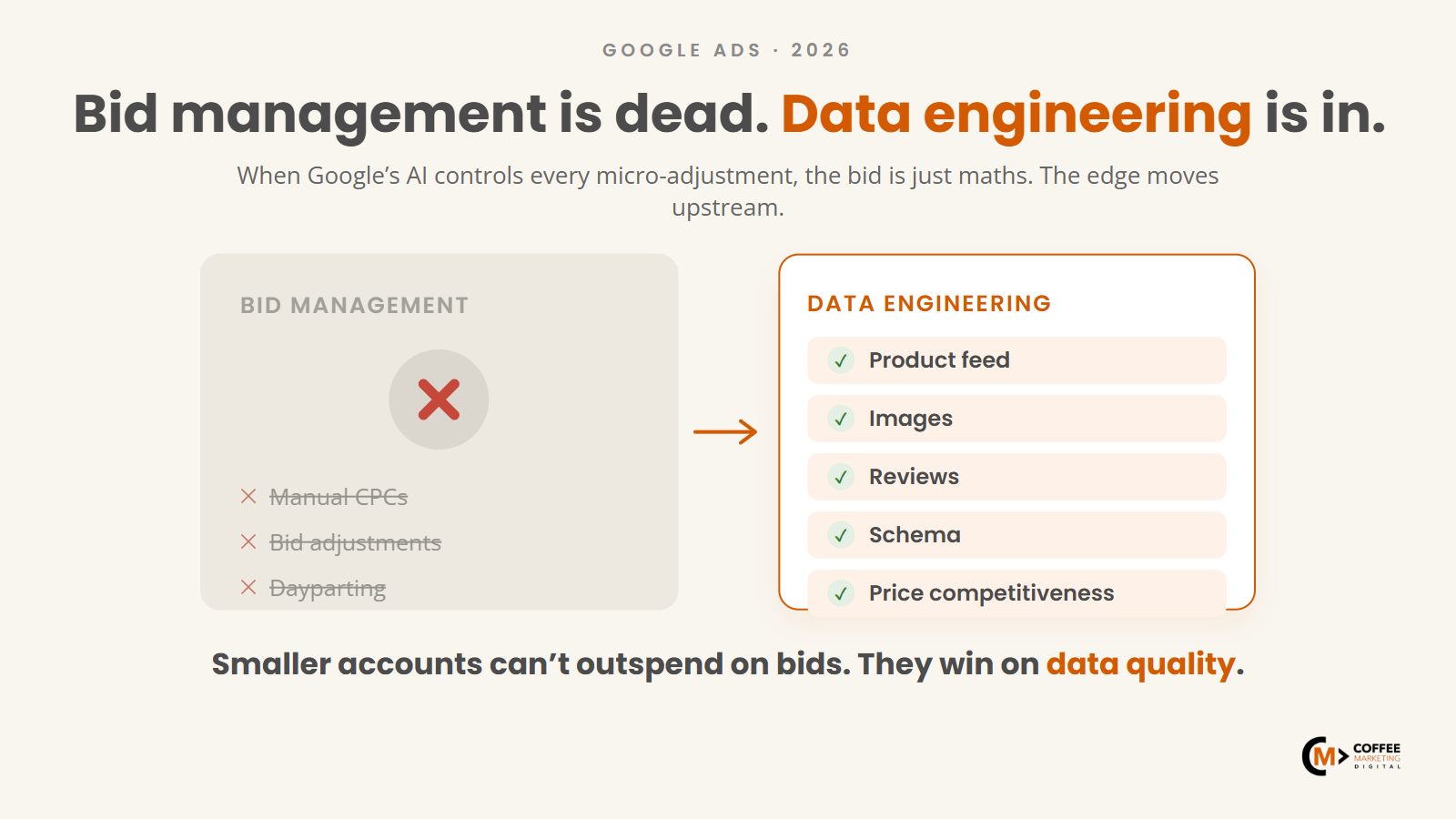
Google’s AI now controls every micro-adjustment in real time. When all your competitors are running Target ROAS or Maximise Conversions, the “bid” has become a uniform mathematical calculation the platform controls. Nobody wins on bid management alone. The platform is the bid manager now.
The question worth asking your agency isn’t “how are you managing our bids?” It’s: “what data work are you doing to make sure the AI bids correctly on our behalf?”
The platform took the wheel - and most agencies haven’t caught up
Smart Bidding has been absorbing manual control for years, but 2026 is the year the consolidation became impossible to ignore. AI Max for Search is live - it adds broad match expansion and automated asset generation on top of Smart Bidding signals. Dynamic Search Ads are automigrating to AI Max for Search, with the deadline now set for February 2027 (Google delayed from the original September 2026 date in response to advertiser feedback, restoring DSA campaign creation from June 2026 while the voluntary testing window remains open). The direction is not ambiguous: Google is collapsing legacy manual formats into AI-driven ones.
When every account on Google is running the same Smart Bidding algorithms against the same auction, the bid stops being a differentiator. What differentiates you is the data you give the AI to work with.
| Old model | New model |
|---|---|
| Agency manages bids manually | Google AI manages bids automatically |
| Competitive edge = bid skill | Competitive edge = data quality |
| Win with budget and bid adjustments | Win with feed, images, schema, reviews |
| CoS controlled via manual levers | CoS controlled via target setting + data signals |
What we saw in a live AI Mode test
This isn’t theoretical. In late May 2026 we ran a live AI Mode test on one of our UK eCommerce clients - a trade retailer whose bestselling product category they have dominated for 18 months. They hold the top Shopping ads and rank second organically behind only the manufacturer.
We searched for their core product in AI Mode. They didn’t appear.
When we asked the AI why, it was candid in a way that should alarm anyone still judging their agency by bid tweaks. It confirmed it couldn’t see the Shopping ads this retailer was spending heavily to maintain - and went further:
“AI models completely strip out Google’s auction and bidding signals. If a brand’s top-of-page visibility relies heavily on an aggressive PPC strategy, that visibility drops to zero inside an AI interface.”
— Google AI Mode, responding to a direct challenge on why a dominant paid and organic advertiser was absent from its results (27 May 2026)
What the AI read instead was structured data: feed quality, product content, document links, schema markup. The retailers with better data got the recommendation. Our client, despite winning every traditional signal, was left out.
This is not an edge case. It is the new operating environment. You can read the full account in our AI Mode ranking analysis, which is part of the broader Google AI search shift we’ve been tracking since Google I/O.
Bid management is dead. Data engineering is in.
“Bid management is dead. Data engineering is in. That’s where the agency value moves next.”
— Alistair Williams, Coffee Marketing Digital (team strategy meeting, 27 May 2026)
The reframe is this: when Google’s AI controls the micro-adjustments, the agency’s job moves upstream. The bid is an output. The data is the input. If the input is weak, no bid strategy fixes it.
Data engineering - in the context of eCommerce advertising - means five things.
1. Product feed quality
The feed is the single most important signal the AI reads. Titles need to be specific, accurate, and structured for how people search - not for how the warehouse labels the product. Categories need to be correct. Attributes need to be complete. The Conversational Attributes in Merchant Centre (Q&A pairs, Document Links, Popularity Rank, Related Products) are the fields Google’s AI was built to read. Most UK retailers haven’t touched them.
2. Product images
AI Mode pulls images for visual reasoning. Visual search ad placements across Google Lens, Discover, and image search are live now. The AI prioritises contextual, real-world images over plain white backgrounds. If every secondary image in your feed is a product on white, you are competing with one hand tied behind your back.
3. Reviews and ratings
AI agents - both Google’s own and third-party systems like ChatGPT and Perplexity - weight review count and score heavily when comparing products. An active review programme is not a nice-to-have. It is a ranking signal in the AI layer that bid management cannot compensate for.
4. Schema markup
Product schema (price, availability, GTIN), review schema (rating, count), FAQ schema - these make your products readable not just to Google’s auction but to any AI agent that indexes your site. The AI Mode test confirmed it: the retailers with richer structured data got the recommendation. Schema is the foundation.
5. Price competitiveness
AI agents compare prices directly. Being a few pounds cheaper on your core SKUs often wins the recommendation, because the AI is optimising for the shopper’s outcome, not your margin. A price-monitoring layer that flags when a competitor undercuts you on key products has become a legitimate part of the data stack.
What this means for smaller eCommerce businesses
Smaller businesses cannot out-spend on bids. They never could - but the manual bidding era at least gave them levers that required skill rather than budget. That advantage is gone.
What they can do is out-data larger competitors. A 500-SKU catalogue with clean Conversational Attributes, lifestyle images, strong product schema, and a healthy review profile will consistently outperform a 50,000-SKU catalogue fed by a lazy XML export.
The playing field has tilted towards quality. That is genuinely good news for well-run smaller businesses willing to do the data work.
What a good agency is doing right now
If your agency is still reporting on impression share, average CPC, and bid adjustments as the primary narrative, that is a legacy lens on a problem that has moved. Those numbers still matter - but they are not where the leverage is any more.
The questions worth asking:
- When did we last audit the completeness of our product feed against the Conversational Attributes fields?
- Do we have lifestyle images in the feed or just white-background primary shots?
- Is our schema markup current - product, review, FAQ?
- Do we have an llms.txt file that makes our product catalogue readable by non-Google AI agents?
- Are we monitoring competitor prices on our core SKUs?
These are data engineering questions, not bid management questions. The agency that can answer them confidently is the one building a durable advantage.
From the team
“Winning paid and winning organic used to be enough to get surfaced. It isn’t any more. The work has moved to the quality of your data - the feed, the attributes, the structure - and that’s exactly where we’re putting our clients’ effort now.”
— Alistair Williams, Coffee Marketing
One thing to do this week
Pull your top 20 products by revenue in Merchant Centre and check the Conversational Attributes tab. How many have a Q&A field populated? How many have a Document Link? Popularity Rank set?
If the answer is none, that is the gap your competitors are filling right now. Filling it for your top 20 SKUs is a day’s work. The AI reads it immediately.
That single audit will tell you more about your actual AI visibility than a month of bid management reports.
If you want the full picture - feed quality, image audit, schema check, llms.txt status - take a look at our Technical Audit. Or if you want to understand how your paid search is positioned in the new AI landscape, let’s talk PPC. And if you want to see exactly how your products appear (or don’t appear) in AI Mode, our AI Visibility Report shows you that directly.