ChatGPT Ads Have Landed in the UK: What Advertisers Need to Know

More of your customers are starting their buying journey by asking an AI. Not typing three words into a search box and scanning ten blue links, but actually asking ChatGPT "what's the best cordless drill for a small workshop under £150?" and reading the answer it writes back. That shift has been building for two years — and if you want the fuller picture of how fast it is moving, we wrote about that in AI is reshaping digital marketing right now. What's new is that there is now a paid way into it.
On 6 June 2026, OpenAI switched on advertising inside ChatGPT in the UK — the first market in Europe to get it, following the original US test in February. If you sell online, there is now a way to appear inside the conversation itself, at the exact moment someone is asking for a recommendation.
Here's the trap. It looks like search, so the instinct is to run it like Google. It isn't Google, and treating it that way is the fastest route to a wasted budget. Get the difference right, though, and you are early to a channel most of your competitors haven't even opened.
We've put our money where our mouth is on this: Coffee Marketing Digital has opened its own OpenAI Ads account and we are actively testing the platform. Everything below is written from inside the account, not from a press release. It is still an early, fast-moving beta — so treat this as a living guide. As our own test results come in, we will come back and expand this article with what actually works.
ChatGPT ads, in plain English
When a Free or Go user asks ChatGPT something with commercial intent, a single clearly-labelled Sponsored unit can appear below the answer — advertiser name, a title, a line of copy, an image and a link. For shopping queries, that can become a product card or a small carousel showing price and reviews. It sits apart from the answer and is always labelled. Crucially, the ad appears inside the conversation itself — rendered inline, directly beneath ChatGPT's reply, not on a separate search-results page.
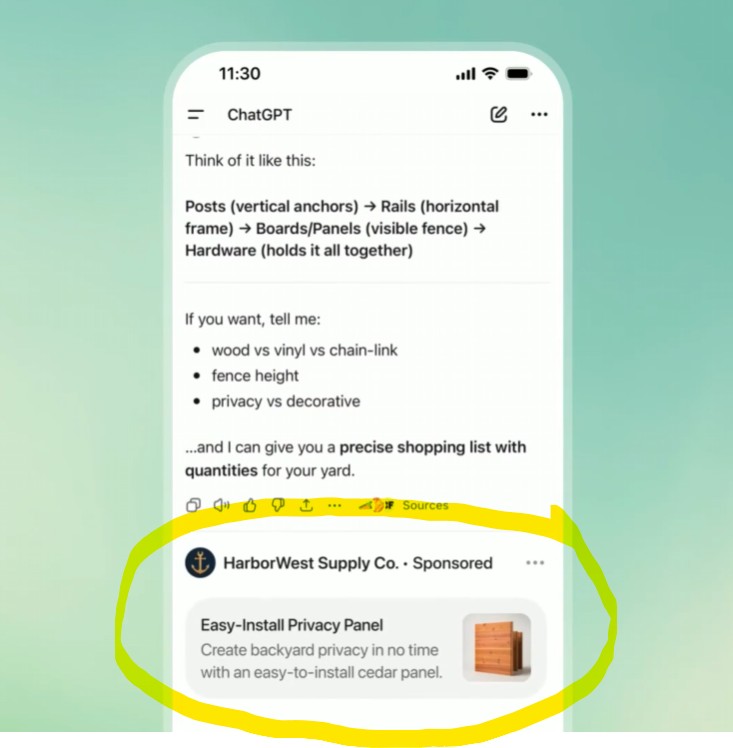
Two things surprise people:
- Only Free and Go users see ads. Anyone on Plus, Pro, Business, Enterprise or Edu gets an ad-free experience. So the audience you're buying is the free tier, not the heavy paying users.
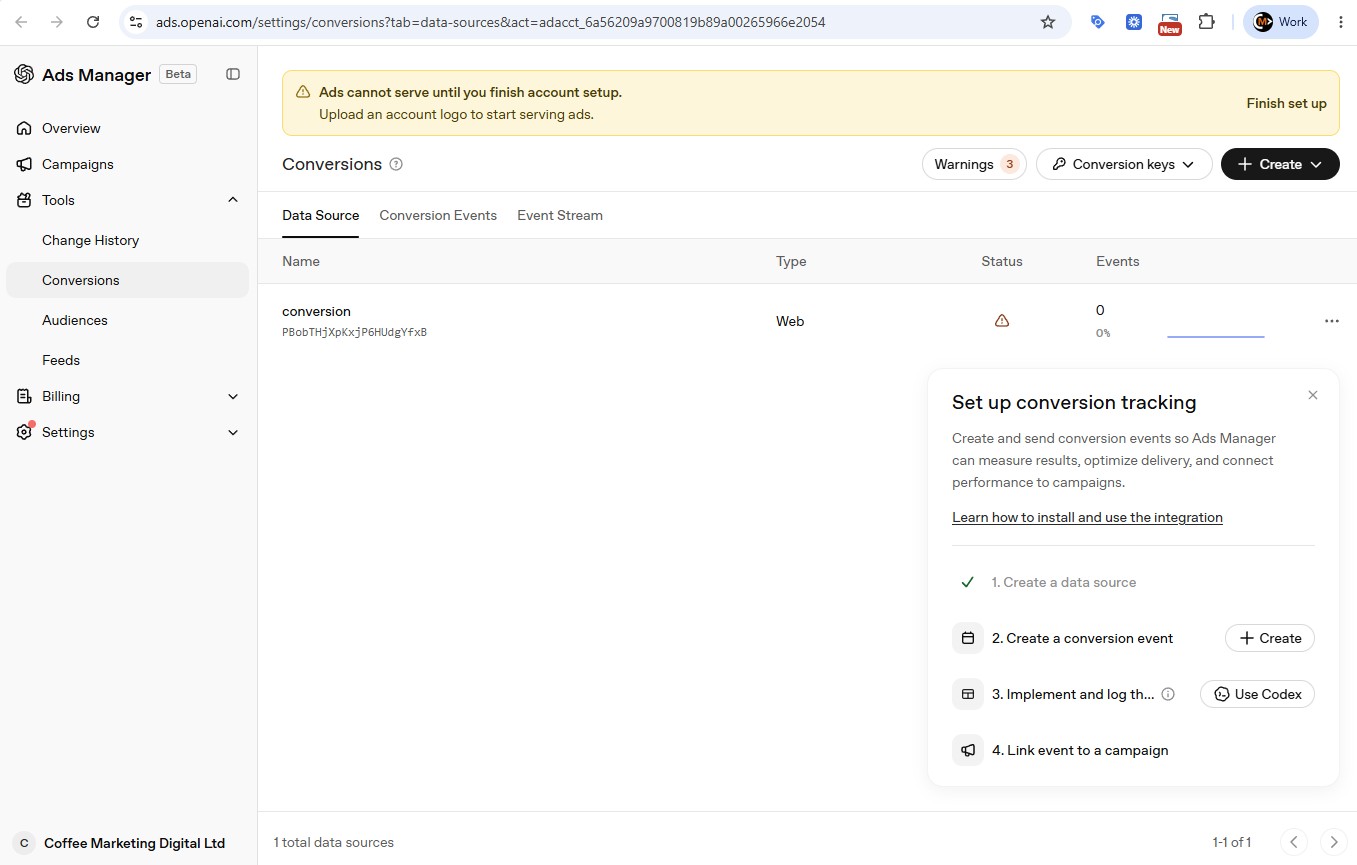
- It's still a beta. The platform is literally badged "Ads Manager Beta", and until you finish account setup and business verification, nothing serves at all.
It's live in the UK — but it's early
The UK went live on 6 June 2026. From inside our own account, three things are worth knowing before you plan anything:
- You bill in pounds. Our account is a UK limited company and budgets are denominated in £ GBP in the interface, not dollars.
- You can target the UK cleanly. "Locations for this campaign" is a first-class setting — set it to United Kingdom and the campaign only shows here. There's a matching exclusion list, and exclusions win.
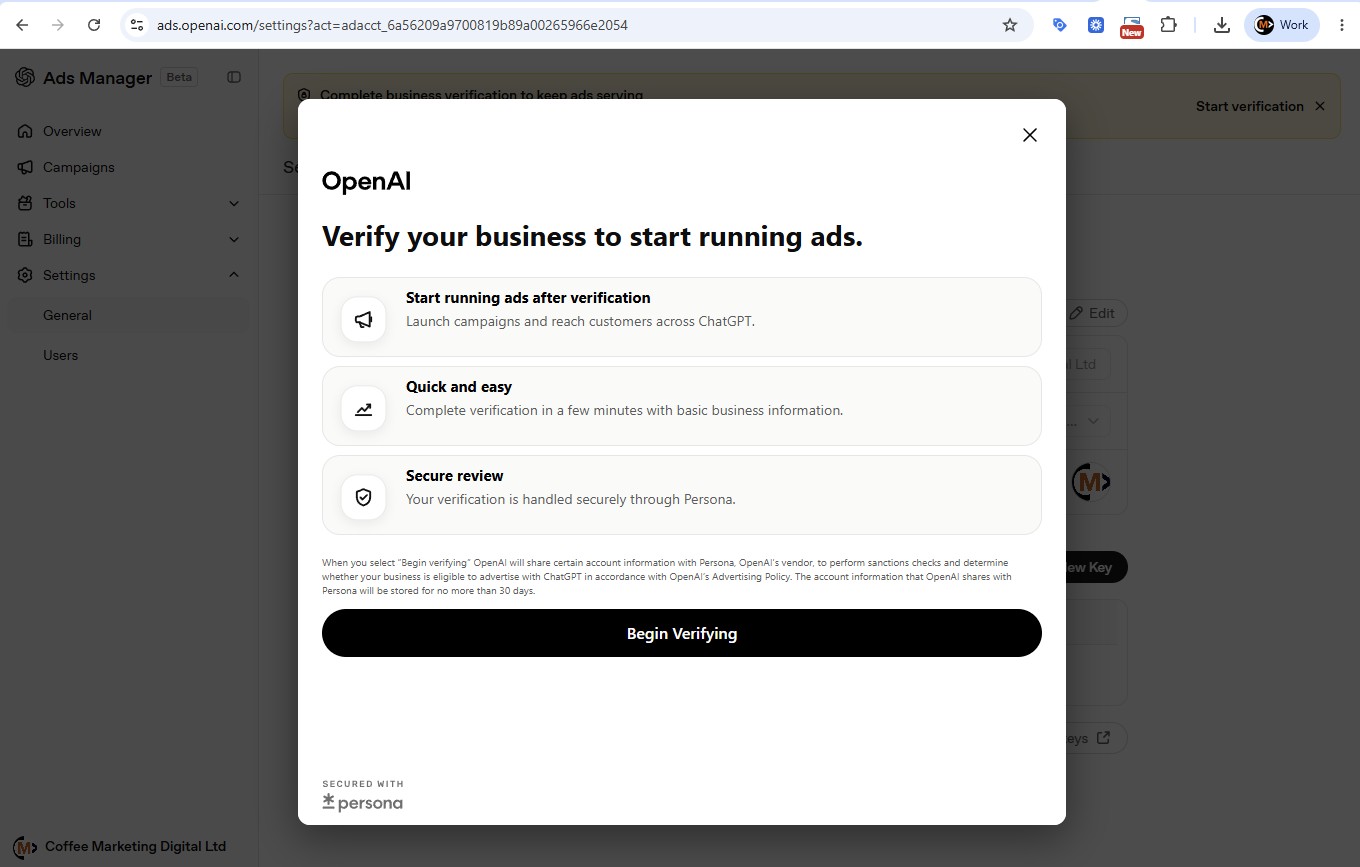
- You must verify your business first. Verification runs through Persona (OpenAI's identity vendor) and covers sanctions and eligibility checks. We submitted ours and it went straight into review — OpenAI says this takes a few days. No verification, no serving.
The big difference: you can't buy a keyword
This is the part that catches every experienced advertiser, and it's the single most important thing to understand.
On Google, you bid on the words a customer types. You choose keywords, you choose match types, and you control, to the letter, which queries you're willing to pay for. On ChatGPT there are no keywords to buy. Instead you write context hints — plain-English descriptions of the conversations and topics where your product belongs — and the model decides when you're genuinely relevant to what someone is discussing. There is no guaranteed delivery and no exact-match precision. You're buying contextual relevance, not query control.
Pricing works on a relevance-weighted second-price auction (you pay just above the next competing bid, adjusted for how relevant the system thinks you are), and you can buy on CPC (cost per click) or CPM (cost per thousand impressions). OpenAI suggests a starting maximum CPC of $3–5, which lands at roughly £2.50–£4 in a sterling account.
On Google you buy the words a customer types. On ChatGPT you describe the conversations you want to be part of, and the model decides. That one difference breaks twenty years of keyword habits.
How it compares to Google, Microsoft and Meta
| ChatGPT Ads | Google Search Ads | Meta Advantage+ | |
|---|---|---|---|
| How you target | Context hints — describe the conversation | Keywords — match the query | Interests + AI signals |
| Buying model | CPC or CPM, second-price auction | CPC, second-price auction | CPM / optimised CPM |
| Starting bid guidance | ~£2.50–£4 max CPC | Keyword-dependent | Auction-set |
| Who you reach | Free & Go ChatGPT users | Everyone searching Google | Facebook & Instagram users |
| Creative | Sponsored unit / product card + reviews | Text ad / Shopping listing | Image / video / carousel |
| Advertiser control | Low — the model judges relevance | High — keyword + match type | Low–medium |
| Maturity | Beta (2026) | 20+ years | Mature |
The honest summary: this is closer to the contextual buying of early Meta than to the intent buying of Google Search. You give up precision and hand relevance decisions to the model. In exchange you reach people at a genuinely new moment — mid-conversation, mid-decision.
As consumers increasingly turn to AI for searching for products and recommendations, AI generated product results will dramatically increase and eventually supersede the old means of advertising products online. OpenAI's ChatGPT is the first into the ads market with paid-for placements with a more trusted and personable means to suggest your products to relevant audiences, so it made sense for us to test it on ourselves first.
Setting it up: what the account actually looks like
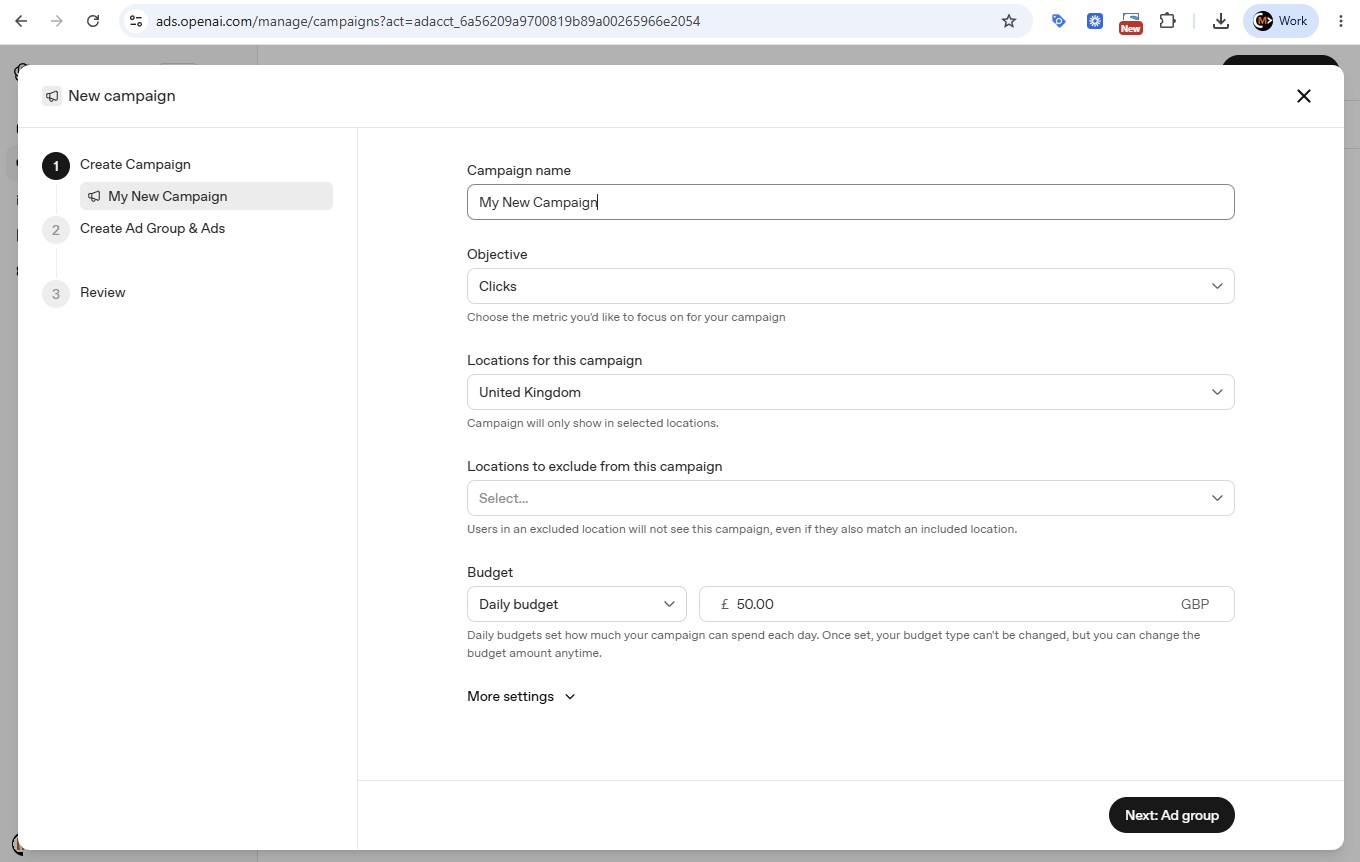
The campaign builder is refreshingly simple. You name the campaign, pick an objective (Clicks or Reach), set your location to the United Kingdom, and set a daily or lifetime budget in pounds. One thing to note: once you choose daily or lifetime, the budget type is locked — you can change the amount but not the type.
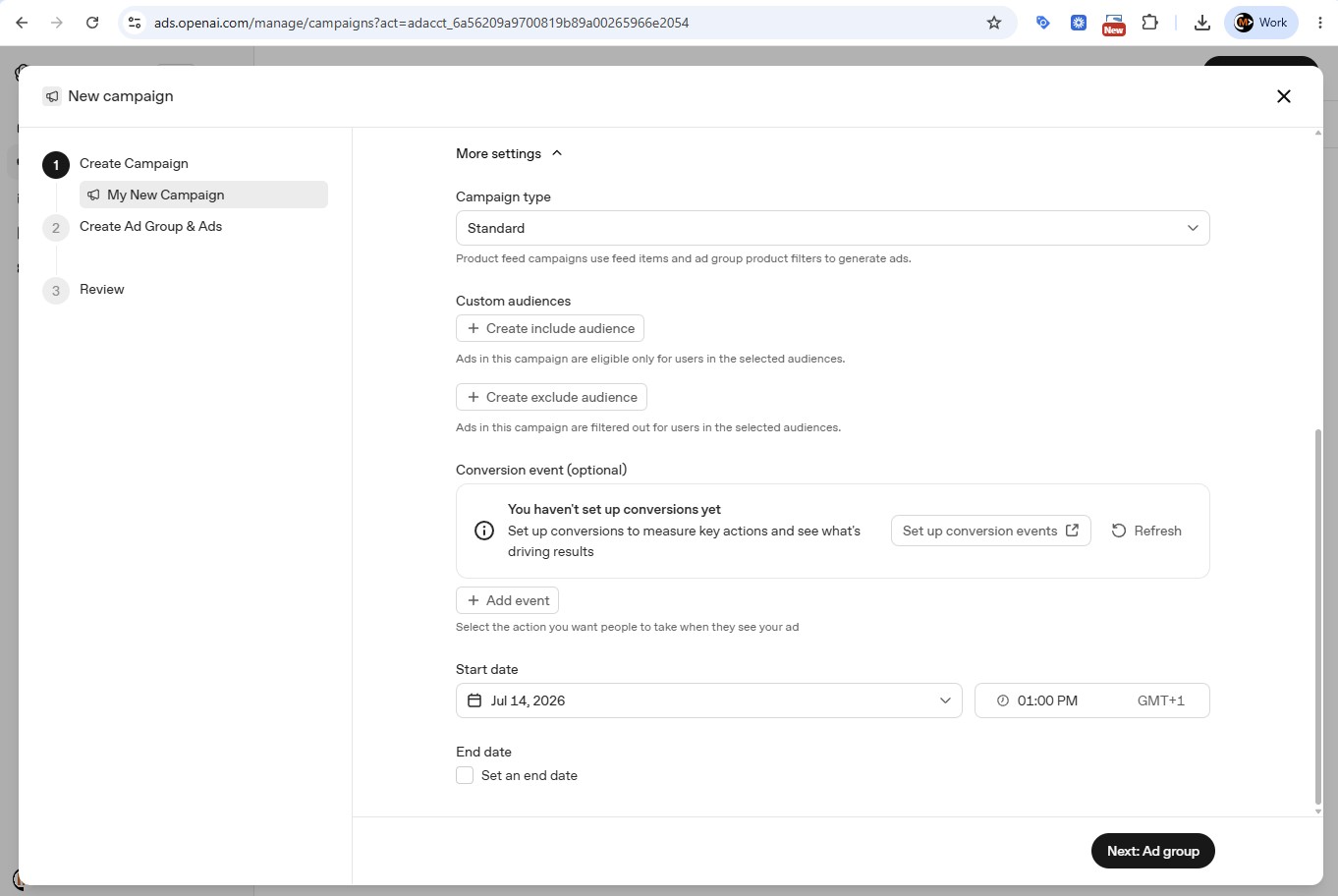
Under "More settings" you'll find the pieces that matter for eCommerce. Campaign type is either Standard or Product feed — feed campaigns generate ads from your product feed and ad-group filters, which is how the shopping-style cards get built. You can also attach custom audiences and link a conversion event.
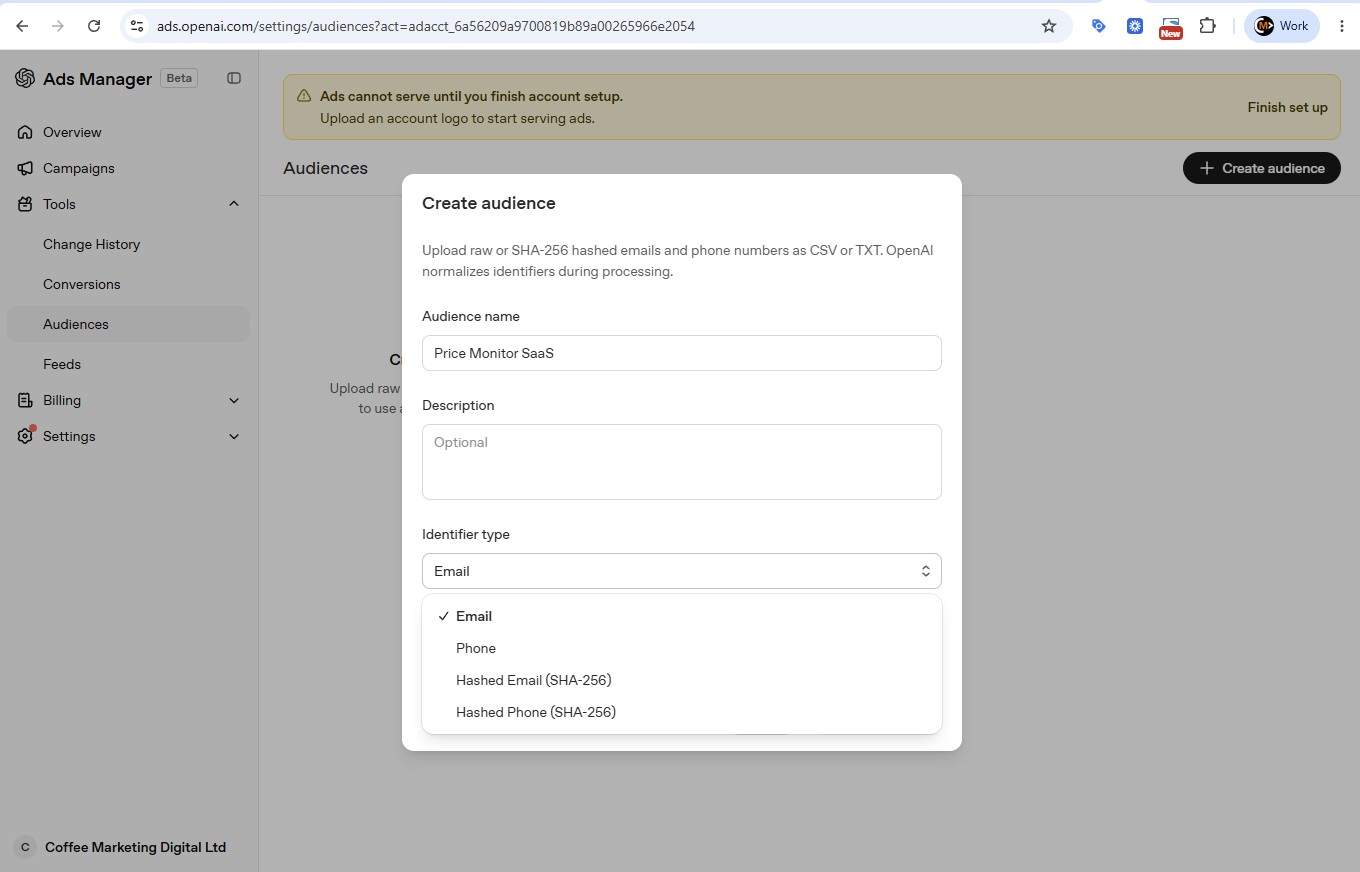
Those custom audiences are more powerful than they first appear. You can upload your own email or phone lists — raw, or SHA-256 hashed — and either include or exclude them. That means you can suppress existing customers from an acquisition campaign, or build a lookalike-style seed from your best buyers. One caution for UK advertisers: you need a lawful GDPR basis before you upload anyone's data, so treat this exactly as carefully as you'd treat a Customer Match list on Google.
Measure it on profit, not the platform's word
Here is where our profit-first discipline matters more than anywhere else. Because there are no keywords, no published benchmarks, and the platform's own reporting doesn't yet reliably tell you what each sale was worth, you cannot judge this channel on its own dashboard. You have to measure it yourself — the same principle we set out in Beyond ROAS: a spend vs efficiency framework.
The setup is straightforward. Create a data source (a pixel), create a conversion event mapped to a real action, install the pixel and the server-side Conversions API, and link the event to your campaign. The attribution window is configurable — ours defaults to 30 days. Add static UTM tags to every landing URL so ChatGPT traffic shows up in your own analytics independently of OpenAI's numbers.
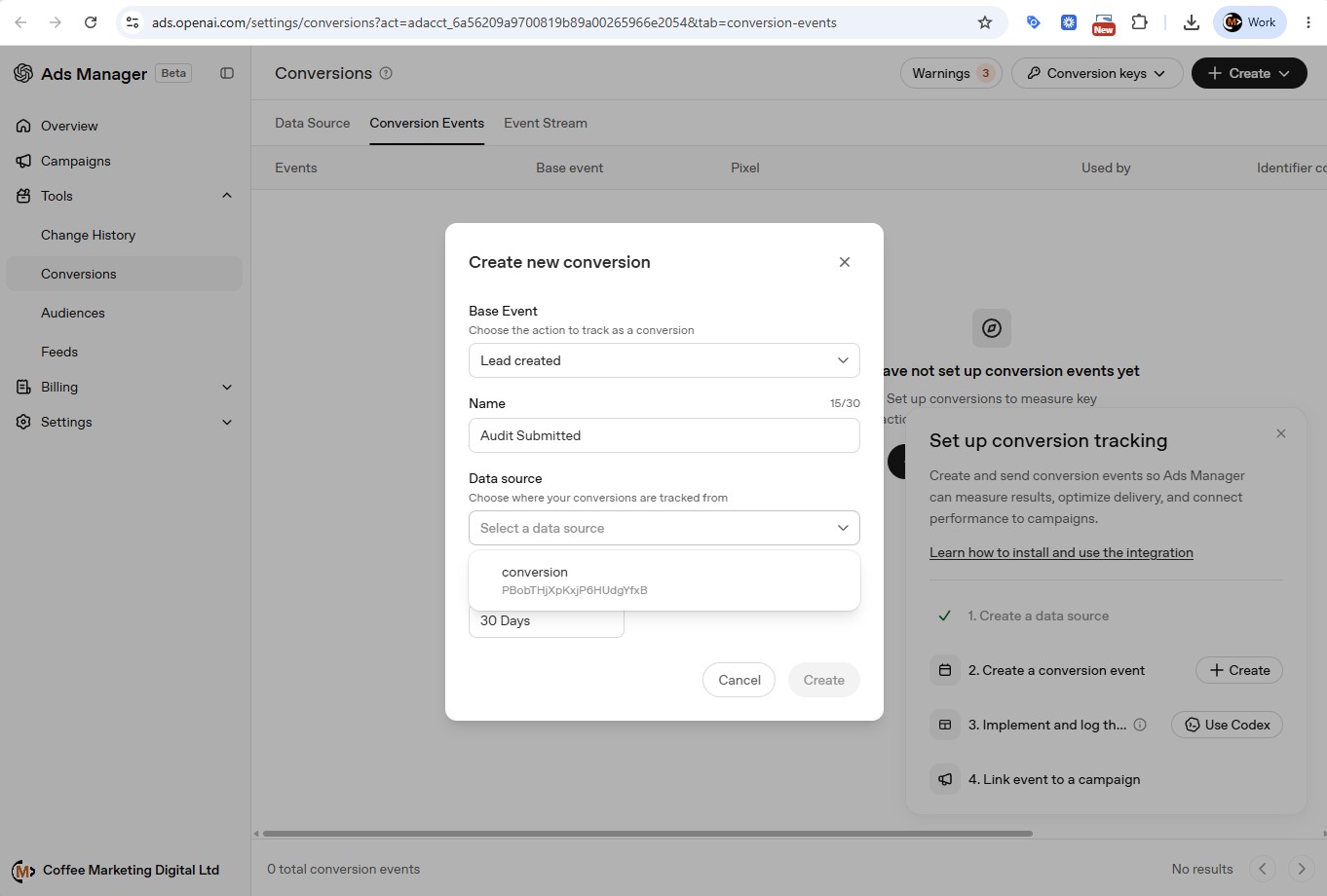
The single most important move: feed profit as your conversion value, not revenue. A £100 order with a 40% margin and £10 shipping is worth £30 to you, not £100 — so pass 30. Then judge the whole channel on Cost of Sale (CoS) — ad spend as a percentage of the sales it generates — because CoS is the number that actually protects your margin.
An illustrative example (there are no reliable ChatGPT benchmarks yet, so these figures are for shape, not prediction):
| Illustrative UK test | |
|---|---|
| Budget | £1,500 |
| Average CPC | £2.80 |
| Clicks | ~535 |
| Conversion rate | 3% |
| Orders | ~16 |
| Average order value | £250 |
| Revenue | £4,000 |
| Cost of Sale | 37.5% |
If your target CoS is 30%, that test is over target on the face of it — but if those are new customers with strong repeat value, the lifetime picture may still stack up. The point isn't the numbers; it's the method. Set your target CoS first, feed the pixel profit, and let the test reach a fair sample before you judge it.
The nuances that will catch you out
- You're buying the free tier. Your reach is Free and Go users, not the heavier paying users.
- No agency "manager account" yet. There's no Google Ads MCC equivalent by default — each API key is tied to a single ad account, and multi-account access means talking to OpenAI directly.
- Restricted categories. No ads adjacent to personal health, mental health or politics; no political ads; nothing served to under-18s.
- Genuine unknowns remain. VAT treatment on the first invoice, any minimum spend, and real CPC/CPM benchmarks are all still open questions — which is exactly why we're testing before we recommend budgets.
- You only get aggregated data. Advertisers never see individual chats — only anonymised, aggregated performance.
What to do this week
You don't need to spend a penny to get ready. This week: open a free OpenAI Ads Manager account at ads.openai.com, complete business verification (it takes a few days, so start now), and get the conversion pixel firing on your site with profit as the value. Do that and the day you decide to test, your measurement is already in place — and you'll never judge the channel on a number that doesn't include your margin.
If you'd rather someone ran that test properly — with the tracking wired to profit and the results read against your real Cost of Sale — that's exactly what we're building for our own clients right now. Let's have a conversation about whether ChatGPT ads are worth your budget yet.