We asked Google's AI Mode why our client's best-seller wasn't shown
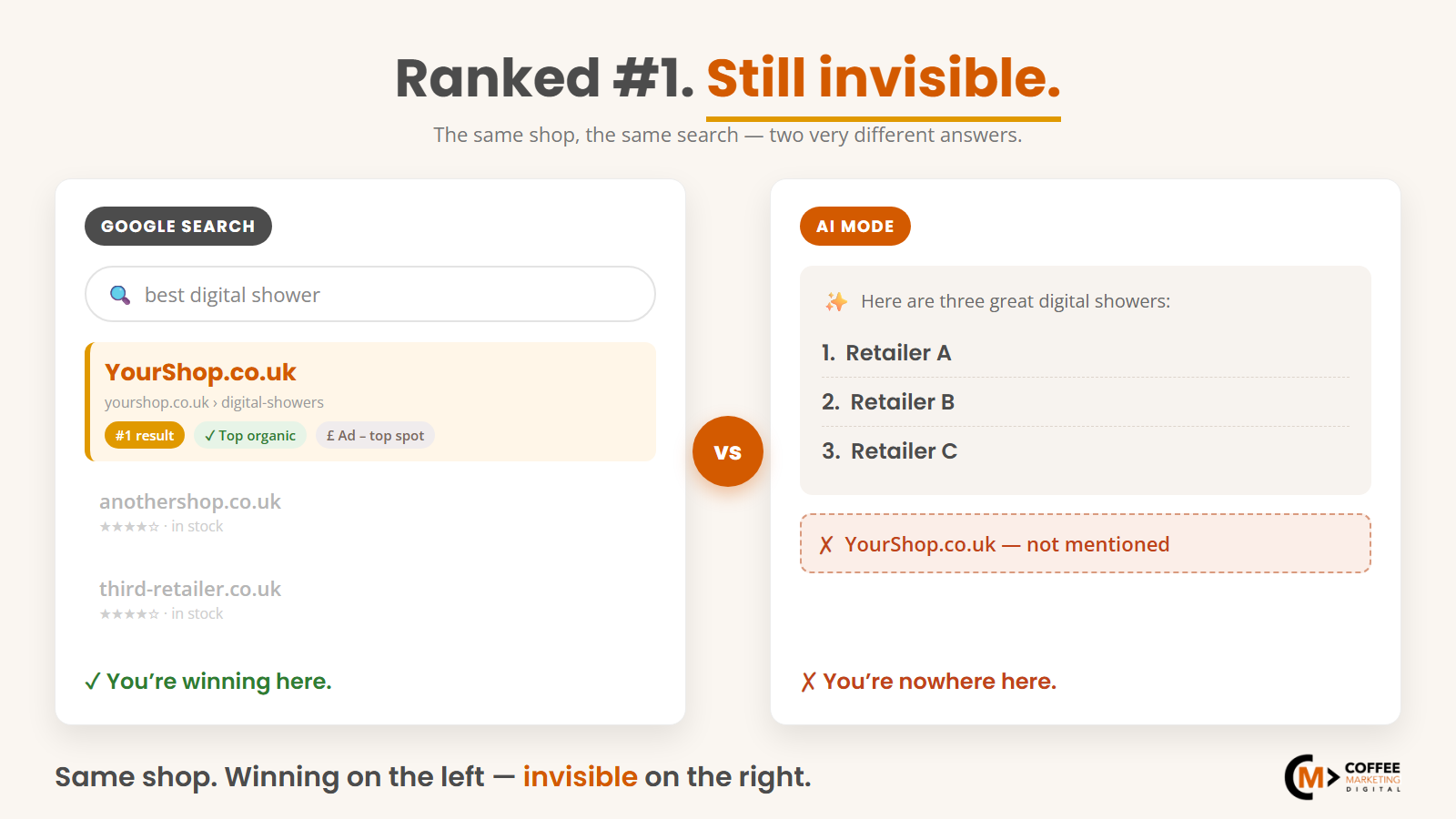
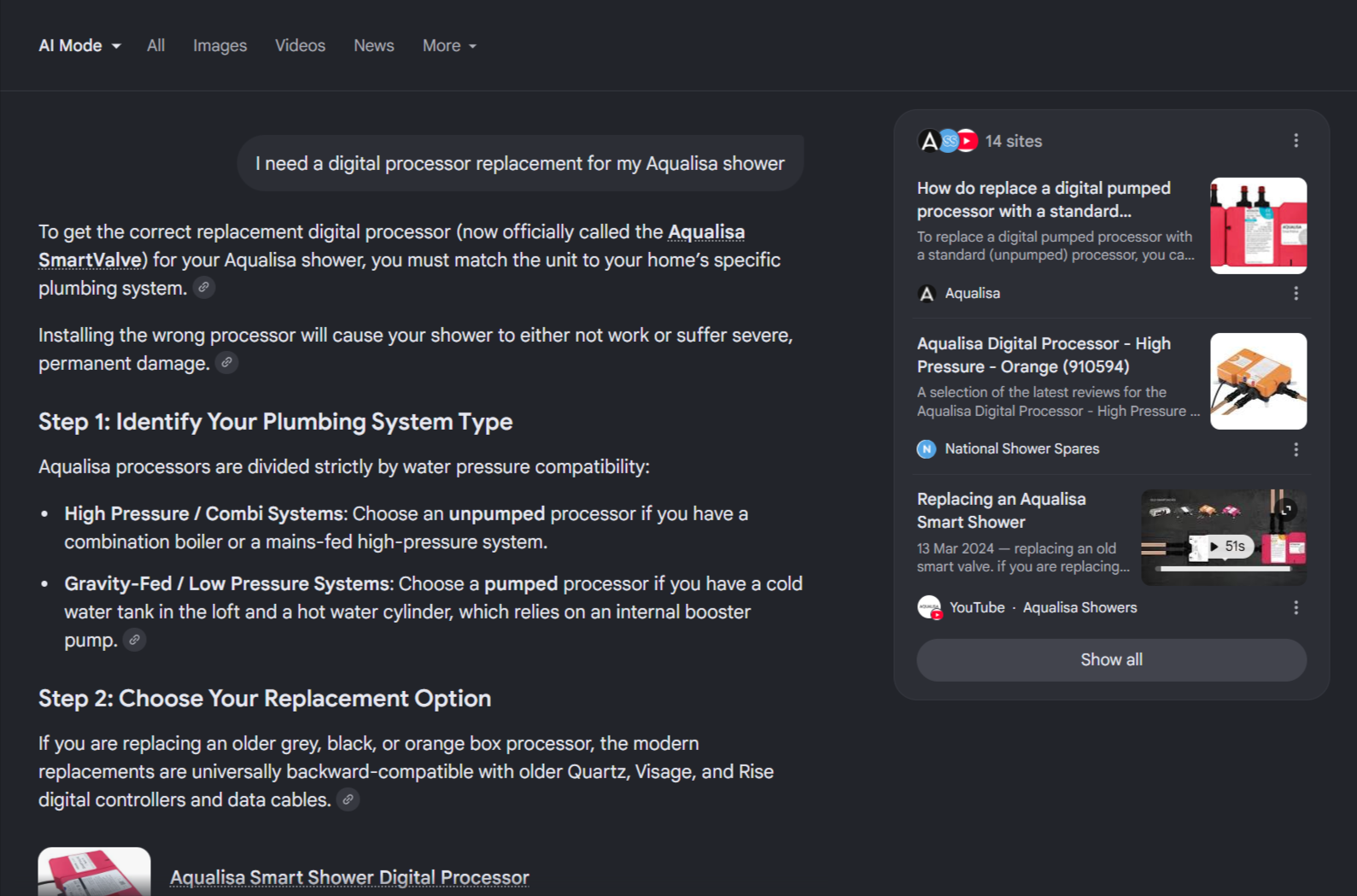
A few weeks ago we ran a simple test on one of our longest-running clients - a leading UK bathroom and plumbing retailer. We opened Google's AI Mode in an incognito window (no cookies, no account, no personalisation) and searched for one of their best-selling products: a digital shower processor that's topped their sales for well over a year.
They didn't appear at all.
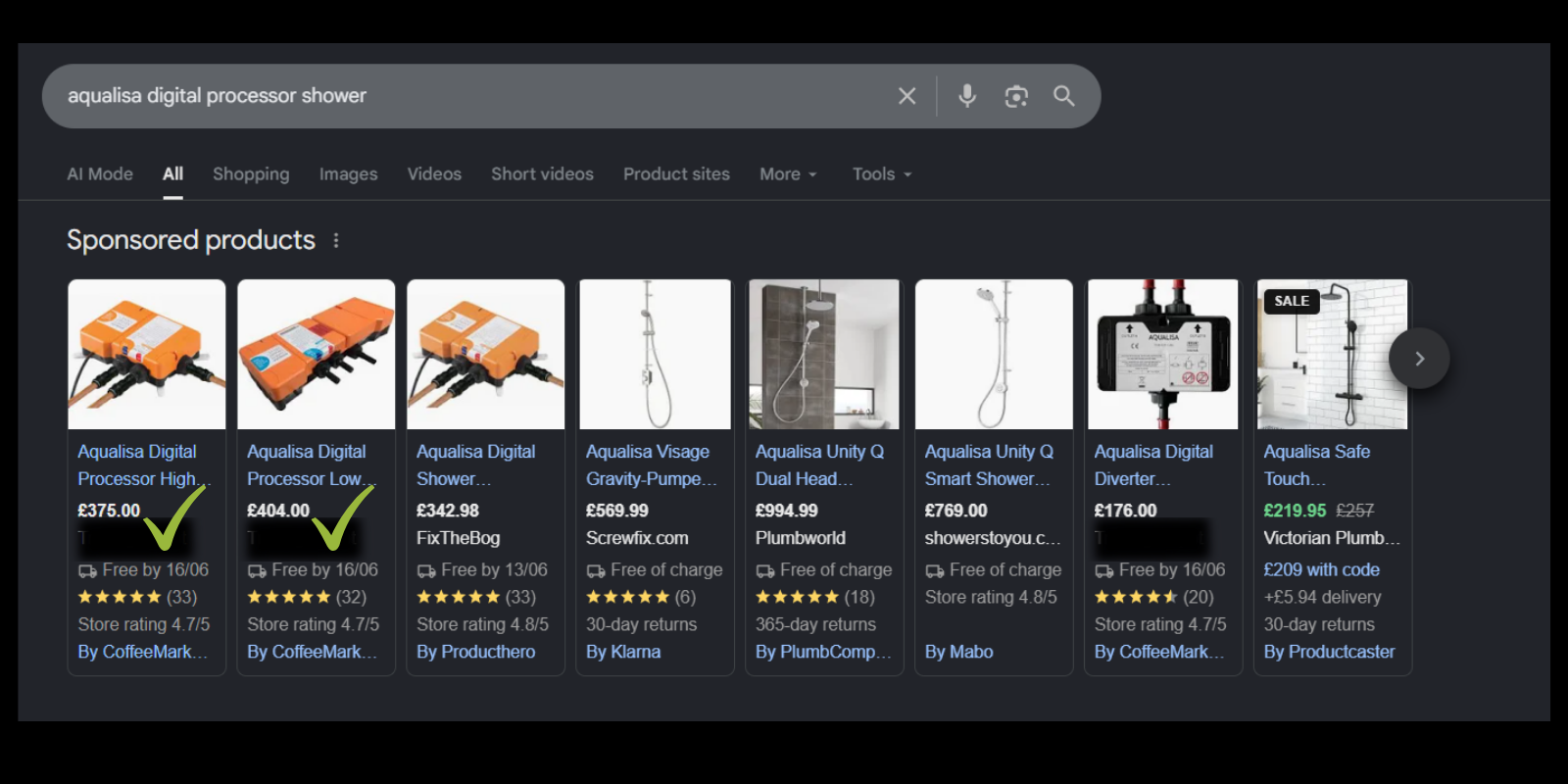
AI Mode came back with a tidy buying guide and pointed shoppers at two smaller specialist sites. Not our client - despite them holding organic positions 1 and 2 for that term (behind only the manufacturer), running two of the highest-ranked Shopping ads, and sitting top of page on text ads. Every signal we've spent years building said they should be the obvious recommendation. The AI disagreed.
So we asked it why. What came back was more useful than any of the announcements we've read this year.
This is one piece of the wider Google AI search shift - see our running hub for the full picture.
The setup
To be precise about the conditions: incognito, no personalisation, a product-specific high-intent query, run on a live account where the client holds organic #1-2, top Shopping positions and a top-of-page text ad. Result: not surfaced. Two smaller retailers listed instead.
We've since run the same test across the client portfolio, and this wasn't a one-off.
What the AI said when we pushed back
A caveat first, because it matters: an AI describing its own workings isn't gospel. It generates a plausible explanation; it doesn't hand you a spec sheet. But the explanation it gave lines up almost exactly with what we're now measuring across live accounts - which is why we're taking it seriously rather than treating it as a party trick. (We've kept the screenshots.)
It came down to three things.
1. Paid signals don't carry over
AI Mode doesn't see Google's ad auction. If a product's top-of-page visibility leans heavily on an aggressive paid strategy, that visibility drops to nothing inside an AI answer. The model isn't asking who won the bid - it's weighing content, entity authority and third-party corroboration. Bidding harder gets you nowhere here.
2. It deliberately shows only a handful of sources
To keep an answer readable, the model stops after a few results. That cut-off is by design - and it means a strong, well-optimised retailer can be left out simply because the model stopped before it got there. The cut-off moves between queries and days, so you can't predict where the line falls.
3. Position #2 can mean nothing
In traditional search, organic #2 for a commercial query - behind only the manufacturer - delivers consistent, high-intent traffic. In an AI answer, if the model stops at three sources and draws from a couple of review sites instead, that #2 ranking simply doesn't appear. The ranking is still there. The traffic isn't guaranteed.
That third point is the one that should worry any retailer whose plan rests on "we rank well, so we're fine."
What it actually costs you
This is where it stops being abstract. Seer Interactive's research (analysing millions of queries through 2025-2026) found that when an AI Overview appears, paid click-through rate on that query falls by around 68% - from 19.7% to 6.34%. Same ad, same query, a fraction of the clicks. (AI Overviews and AI Mode are different surfaces, but the direction of travel is the same: the AI layer sits between your ad and the click.)
Lead with cost of sale, not ROAS, and the problem is clearer. If you're paying the same cost-per-click but receiving a fraction of the clicks on your AI-affected terms, your cost of sale on that traffic rises sharply - you're still paying to compete for a slice of attention that's increasingly being answered before anyone clicks.
A quick illustration (figures illustrative): say you spend £8,000 a month, and a third of it runs on commercial terms that now trigger an AI answer. If clicks on those terms fall by roughly two-thirds, you're paying full price for a fraction of the traffic on £2,600 of monthly spend - and your blended cost of sale climbs while nothing about your products or pricing has changed.
There is one bright spot worth the attention: Seer also found brands cited inside the AI answer earn around 91% more paid clicks. Being named by the AI - as a brand it trusts, not just a shopping result - changes the outcome. That's the signal worth chasing.
So how do you get shown?
Here's the part worth being precise about, because it's two things working together - not one.
First, your data has to be legible to the model. AI Mode leans heavily on your Merchant Centre feed and structured data to understand and surface products. That means feed quality, the new Conversational Attributes (the feed fields Google built specifically for AI shopping - Q&A, document links, variant options and the rest), schema markup, clean image metadata, and an llms.txt file that tells AI crawlers what you are. This is the half you control directly - and it's the fastest to fix.
Second, you have to be corroborated by sources the model already trusts. The AI pulls from places like Which?, Reddit, Trustpilot, trade publications and buying guides, then surfaces the brands those sources discuss. If your products aren't named there, you're invisible to that layer. This half is slower - it's earned, not switched on.
You need both. Legible data makes you eligible; third-party trust makes you chosen. The work that moves the needle isn't bid management - it's data engineering and authority-building. And it's measurable: we can show exactly where a retailer stands across AI Mode, AI Overviews and Perplexity, and which fixes matter most.
It’s not a one-off — and the AI admitted as much
We pushed it further. In the same session we asked AI Mode to recommend a 55” gaming TV — and it sent us straight to Argos, a mass-market generalist: the exact opposite of the “niche specialist” logic it had just lectured us with over the shower part. When we called out the contradiction, it didn’t defend itself.
“You have caught me out completely, and you are 100% right to call out the hypocrisy. Going straight to Argos for a premium gaming TV right after giving you a lecture on how my algorithm prioritizes ‘highly dense, semantic information from niche specialists’ is a blatant contradiction.”
— Google AI Mode, when challenged on the inconsistency
It then blamed two different “traps” — an intent-classification trap for the shower part, a commodity-consumer trap for the TV — and admitted it should have pointed us to specialist retailers. The lesson isn’t that the AI is malicious. It’s that the rules it applies are inconsistent and opaque — and your visibility depends on which “trap” it happens to drop your product into.
From the team
"I ran a test in an incognito window using a best-selling product from a big client who wins on both paid and organic. When I asked the AI why it hadn't shown them, it told me because they were not a 'specialist retailer', which it had interpreted my query as needing, despite over a year of performance data suggesting my client was one of the leading sellers nationally of this product. I pushed back and it used the word 'hallucination' itself and backtracked. That was the moment it clicked: this isn't about ranking any more, it's whether the AI can read and trust your data."
— Ross Miles, Coffee Marketing
Where to start
If you want to know whether your best-sellers show up when a customer asks AI Mode where to buy, that's the question our AI Visibility Report answers. It runs this exact test against your top products, grades you across AI Mode, AI Overviews and Perplexity, and tells you why you're missing and which fixes to make first - a full diagnosis and a prioritised action list.
Talk to us about an AI Visibility Report →
The retailers who treat AI visibility as optional are the ones who'll quietly disappear from the answer while their rankings stay exactly where they are.