
llms.txt explained: why ChatGPT, Claude and Perplexity matter as much as Google now
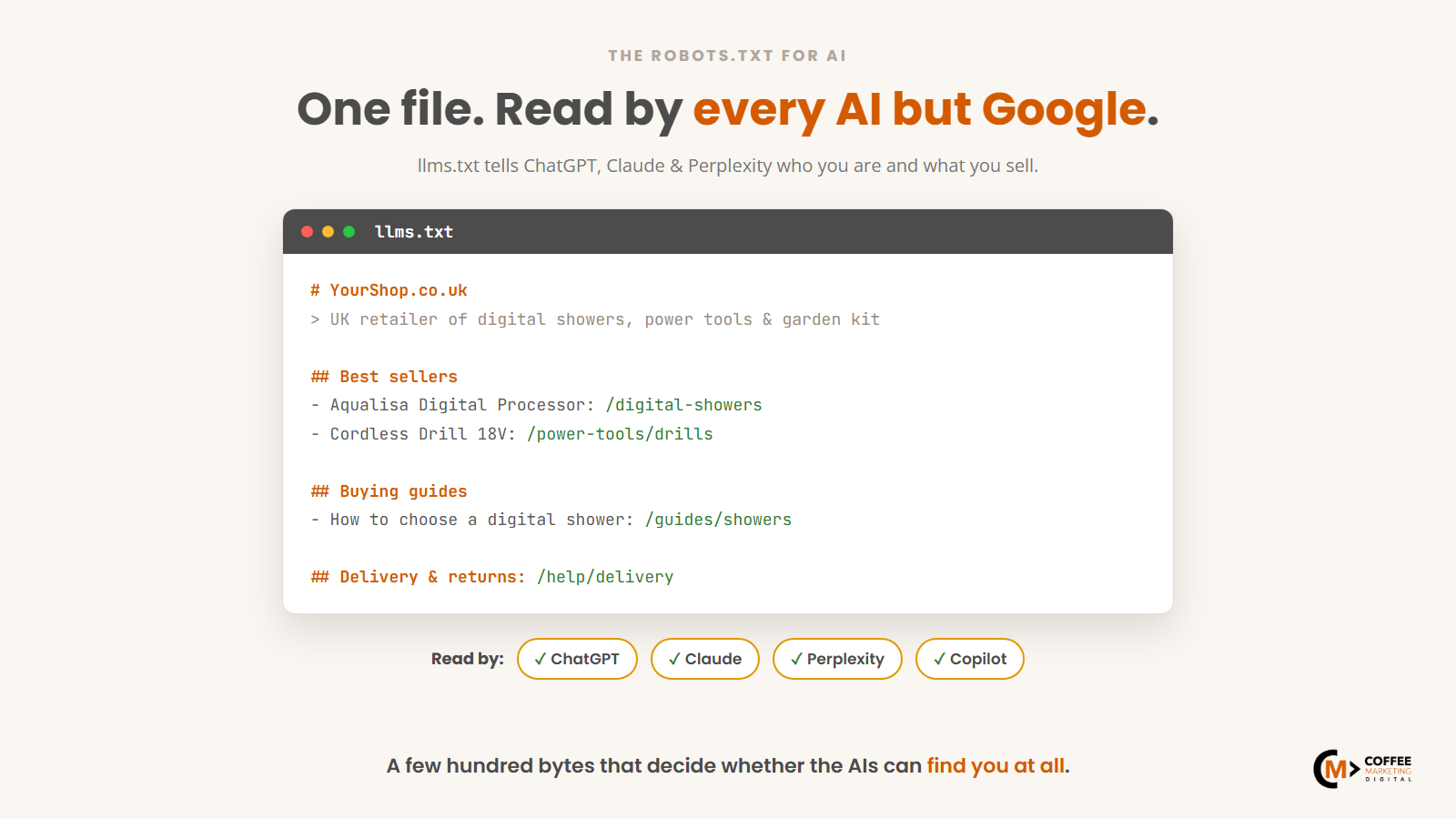
Most UK eCommerce sites have a robots.txt. Almost none have an llms.txt. As of mid-2026, when ChatGPT, Claude and Perplexity decide which retailers to recommend, llms.txt is one of the signals they use - so if your competitor has one and you don't, the AI is reading their products and skipping yours.
llms.txt is a plain-text file that lives at the root of your domain (yoursite.com/llms.txt) and tells AI agents what your site is, what matters on it, and where to find structured information. It is not an official standard yet, but Anthropic, OpenAI and Perplexity all check it - and it has been adopted by the major non-Google AI surfaces faster than almost any prior web convention. For UK retailers, that timing matters.
It is one piece of the wider AI search shift - and the piece that opens you up to the AI surfaces beyond Google.
What llms.txt actually does
Think of it as robots.txt for the LLM era. Robots.txt told search-engine crawlers what to index and what to leave alone. llms.txt tells AI agents what to read, in what order, and why it is relevant.
AI shopping assistants do not crawl the whole web on demand. They prioritise sources that make themselves easy to read and reason about. A well-structured llms.txt puts your categories, bestsellers, delivery policy and brand context into a format an AI can parse in seconds - without scraping your JavaScript-heavy product pages, fighting your pagination, or guessing which of your 14 category URLs is the canonical one.
When someone asks ChatGPT "where can I buy a replacement heating element for an AEG oven in the UK", the AI is not running a live Google search on your behalf. It is drawing from a pool of sources it already understands. llms.txt is one of the cheapest ways to get into that pool.
Why ChatGPT, Claude and Perplexity matter - not just Google
Google AI Mode is the loudest voice in the current shift. It is not the only one. ChatGPT has hundreds of millions of weekly users; Perplexity is the default research tool for a growing share of B2B buyers; and Claude is increasingly embedded in the workflows where trade, B2B and higher-ticket purchases get researched before anyone opens a browser.
Ranking in Google AI Mode while being invisible in ChatGPT means you have solved a third of the problem. Each surface recommends differently, but they draw from a shared pool of AI-ready sources. Competitors who appear in all three are not doing three times the work - they are doing the same foundational work you have not started yet.
For 20 years, getting found online was a Google problem. Now every major AI surface is making product recommendations to your customers. Solving Google alone is solving last year's problem - and it is part of why strong rankings no longer guarantee the click.
What a working llms.txt looks like
The format is deliberately simple. Here is a working structure you can adapt directly:
# Your Brand Name
> One-line description of what you sell and where you operate.

## Main Categories
- [Category 1](https://yoursite.com/category-1): Brief description of what is in here.
- [Category 2](https://yoursite.com/category-2): Brief description.

## Bestsellers
- [Product 1](https://yoursite.com/product/1): Brief specs and what makes it relevant.
- [Product 2](https://yoursite.com/product/2): Brief specs and what makes it relevant.

## About Us
- [Brand story](https://yoursite.com/about)
- [Delivery and returns](https://yoursite.com/delivery)
- [Trade accounts](https://yoursite.com/trade)

## Technical
- [Sitemap](https://yoursite.com/sitemap.xml)
- [Product feed](https://yoursite.com/feed.xml)
The heading structure tells the AI which sections matter most. The inline links give it direct access to the pages that count. The one-line descriptions give it enough context to match your inventory to a query without loading the page first. It does not need to be long - a 50-line llms.txt that is accurate and current will outperform a 500-line file stuffed with marketing copy.
Where most retailers go wrong
- Marketing copy instead of facts. AIs get nothing from "premium quality products for discerning customers." "Power tools, fixings and site safety equipment - UK delivery, trade accounts available" tells them everything.
- Links that 404 or redirect. A broken link signals your source data cannot be trusted. Check every URL before publishing.
- Treating it as a one-off. Regenerate it from your feed and category structure regularly. A six-month-old file with stale categories can actively mislead an AI into recommending products you no longer stock.
- Duplicating the sitemap. Sitemap.xml is a crawl directive for search engines; llms.txt is a reasoning aid for AI agents. Copying one to make the other wastes both.
- No business context. If it does not say you serve trade, operate UK-wide, or specialise in a vertical, you will be missed for the queries where that context is the deciding factor.
From the team
"Honestly? After that AI Mode test my reaction was: get everyone onto llms.txt, like, yesterday. It's the cheapest, fastest thing a retailer can do to make sure the non-Google AIs can actually read them - and almost nobody's done it yet."
— Ross Miles, Coffee Marketing
Where to start
We ran a live AI Mode test on a client account recently (anonymised), and it confirmed what we suspected: paid signals do not transfer into AI recommendation surfaces, and strong organic positions are not guaranteed to carry across either. llms.txt is one of the cheapest ways to get your products into the pool these AIs actually read from - and it pairs with your Conversational Attributes to cover both Google and the non-Google surfaces.
Done properly it takes real knowledge of your site architecture; done badly it is worse than nothing - which is why we build and deploy it as part of a technical audit rather than a quick checklist item. If you want to know where you stand first, that is exactly what our AI Visibility Report tells you: how your products show up across AI Mode, AI Overviews and Perplexity today, and what is missing.