Gemini Spark: the AI Agent That Shops Without Visiting Your Website
Living document — last verified 23 June 2026. We update this as Google confirms more.
What is Gemini Spark?
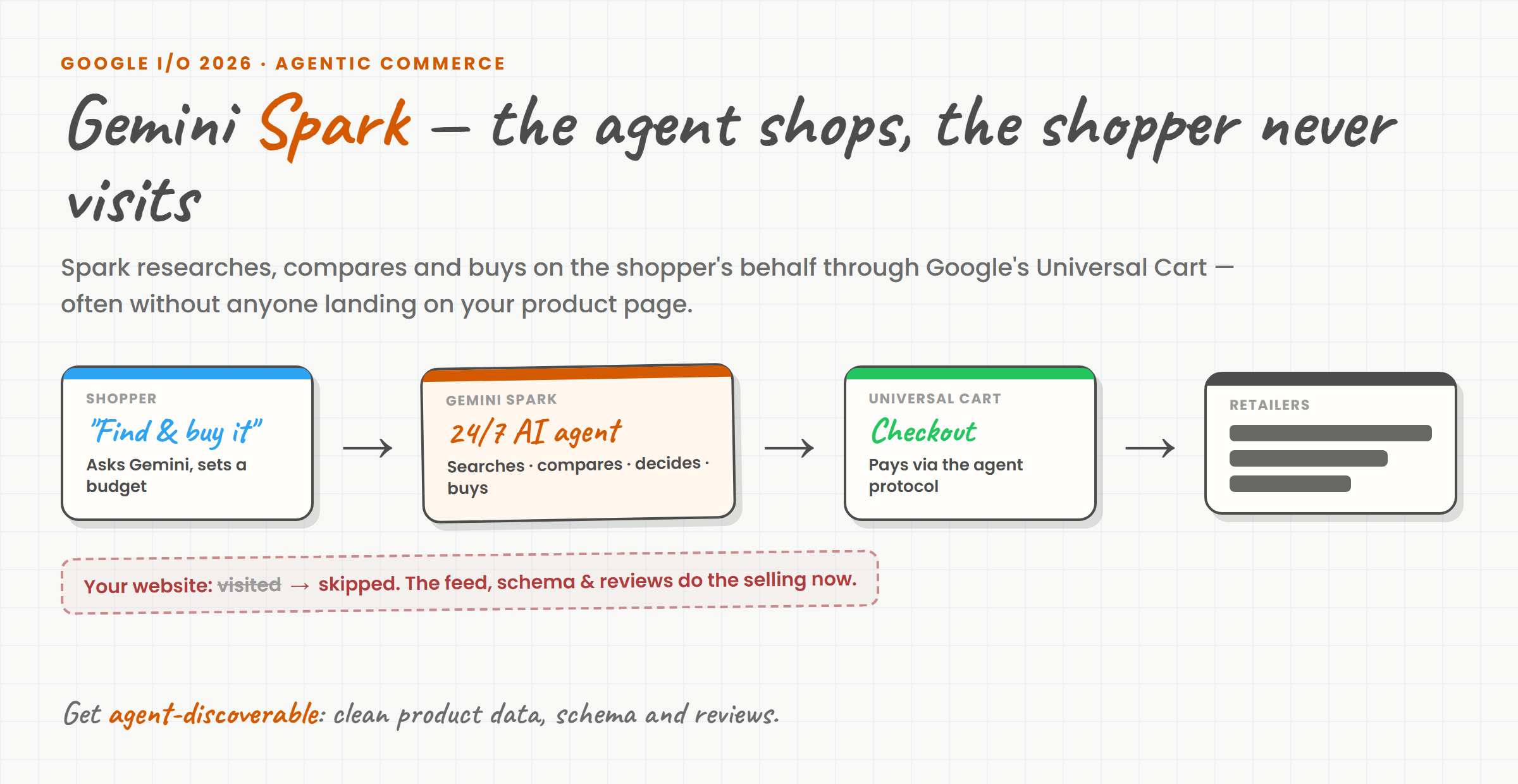
Gemini Spark is Google's 24/7 personal AI agent, announced at Google I/O on 19 May 2026. It runs on dedicated Google Cloud virtual machines (the user's device does not need to be on), integrates with Gmail, Google Docs, Sheets and Slides, and can browse the web through Chrome. As Sundar Pichai described it at I/O: "your personal AI agent that helps you navigate your digital life, taking action on your behalf and under your direction."
The shopping angle — the bit that matters for UK retailers — is this: Spark can research products, compare options, and complete a purchase through Google's Universal Cart, all without the shopper ever landing on a product page. The underlying payment mechanism is called AP2 (Agent Payments Protocol), which lets the agent transact within guardrails the user sets: specific brands or product types, a spend cap, conditions that must be met before it buys.
AP2 is rolling out across Google products starting with Gemini Spark in the coming months. That "starting with" phrasing is Google's own — the shopping capability is not fully live in Spark at the time of writing.
What's confirmed now
The following facts are sourced directly from Google's I/O 2026 announcements and the Google Shopping blog (published 19/05/2026):
- Gemini Spark is real and in beta. At I/O 2026 Google said it was rolling out to Google AI Ultra subscribers in the US the week of 19 May 2026. It is powered by Gemini 3.5 and runs on the Antigravity platform.
- AP2 (Agent Payments Protocol) is coming to Spark. AP2 enables an AI agent to make purchases on a user's behalf within user-defined guardrails (spend cap; specific brands/products; buys only when stated criteria are met). Google confirmed AP2 is rolling out to Google products starting with Gemini Spark "in the coming months." The Google Shopping blog is the primary source.
- Purchases route through Universal Cart (UCP). The Universal Cart is a shared Google-hosted basket that works across Search, the Gemini app, YouTube and Gmail. A shopper can add products while browsing Search, then have Spark complete the purchase — all within Google's surfaces. Retailers connect to UCP via the Universal Commerce Protocol (REST APIs + MCP support). Confirmed launch partners in the US: Nike, Sephora, Target, Ulta Beauty, Walmart, Wayfair, and Shopify merchants.
- UK Universal Cart: confirmed as "later." Google's Shopping blog stated that UCP checkout is coming to Canada and Australia "in the coming months" and "later to the U.K." No firm UK date was given.
- The practical implication is already happening. Regardless of Spark's UK timeline, the underlying pattern it represents — AI agents researching and comparing products before (or instead of) a shopper visiting a website — is already the direction of travel in AI Mode in Search, which is live in test in the UK now.
What this means for UK retailers' product pages and feeds
Whether or not Spark reaches UK consumers this year, the shift in how product decisions get made has already started. AI Mode in Search — which is live in test in the UK — works on the same logic: Google's AI reads your product data, reviews and structured content to decide whether you appear in an answer. A future Spark query runs the same check.
The question an AI agent asks about your product is not "is this merchant's bid high enough?" It is: "does this product reliably match the shopper's criteria?" That match is built from:
1. Your product feed
Conversational Attributes — the newer Merchant Centre fields (question-and-answer pairs, popularity rank, related products, document links to specs and manuals) — are already live in the UK and are what AI Mode reads when assembling a product response. If these fields are empty, your products are at a structural disadvantage against any retailer who has filled them in.
2. Reviews and ratings
AI agents weight review volume and score heavily when comparing options. A product with 12 reviews loses to a comparable product with 180, all else being equal. An active review programme — on Google and on your own product pages — is not marketing; it is infrastructure.
3. Schema markup on your website
Product schema (price, availability, brand, GTIN), Review schema (rating, count) and FAQ schema tell both Google's agents and independent AI tools (ChatGPT, Perplexity) exactly what your product is and whether it is in stock. Schema is how a non-Google AI reads a product page without a crawl.
These are not Spark-specific preparations. They are the same foundations for AI Mode visibility, Universal Cart readiness, and any future agentic commerce surface. The work converges.
What we're still waiting on
These items cannot be confirmed at time of writing. We will update this article when Google provides clarity.
- UK Gemini Spark launch date. Our internal research indicates "within 12 months" of the I/O 2026 announcement — placing it broadly in H1 2027 — but Google has not given a public UK date. The US beta is for Google AI Ultra subscribers only.
- Whether Spark's shopping/AP2 mode is live for current US users. At I/O, Google said AP2 is coming to Spark "in the coming months." It is not confirmed as live at time of writing.
- How UK merchants will opt in (or out) of Universal Cart. US merchants join via a waitlist through Google's support contact form. UK-specific onboarding mechanics are not documented because the UK is not yet live. The Canada and Australia launches will be the closest proxy.
- Commercial terms for AP2 transactions. Whether Google charges any fee on purchases completed via Google Pay in-cart (versus merchant handoff to the retailer's own site) is not stated in Google's launch materials.
- AI Performance Insights UK rollout. This Merchant Centre feature shows share-of-voice in AI Mode and the Gemini app — directly useful for measuring agent-readiness. It is not on the UK launch list as of June 2026.
- Whether opting out of Universal Cart affects AI Mode visibility. One reported comment from Google Marketing Live — that merchants who do not connect may see reduced discoverability — has not been formally documented. We are tracking this.
What UK retailers should do now
The Spark UK timeline is measured in months, not years. The lead time on the underlying work — feed quality, schema, reviews — is also months. Waiting for a UK launch date to start is waiting too long.
The three highest-leverage actions, in priority order:
1. Audit your Conversational Attributes coverage. Log in to Merchant Centre and check how completely the newer feed fields are filled. Gaps here are the fastest path to AI-Mode and agentic invisibility. This is not a trivial exercise for a catalogue of any size — it requires a structured audit, not a spot-check.
2. Check your product and review schema. Run your top product pages through Google's Rich Results Test. Missing or broken schema means AI surfaces (Google and otherwise) cannot reliably read your products. The fix is technical but scoped.
3. Start (or accelerate) your review programme. Review volume is an agent-ranking signal that only compounds over time. There is no shortcut.
If you want a clear view of where your site stands against the full set of agent-readiness signals — feed coverage, schema, llms.txt, AI Mode visibility — our AI Visibility Report is the diagnostic starting point.
For the broader context of how agentic commerce connects to AI Mode, Universal Cart, and what Google's 2026 announcements mean for your search presence, read our guide: Google AI Mode 2026: what the shift to AI search means for UK retailers.
If you are a retailer starting to think through the Universal Cart stay-or-go question, our article Universal Cart UK: should your business join or wait? sets out the decision framework.
For the Merchant Centre feed work that underpins agent discoverability, Conversational Attributes: the UK merchant guide is the practical starting point.
The one action to take this week: open Merchant Centre, pull a sample of your top 20 products, and check how many have Conversational Attributes filled in. That single data point will tell you whether you have a gap — and how urgent it is.
Update log
| Date | Update |
|---|---|
| 23/06/2026 | First published with confirmed I/O 2026 detail. Google Shopping blog and Sundar Pichai I/O 2026 keynote used as primary sources. UK launch date, opt-in mechanics, and AP2 live status noted as unconfirmed. |